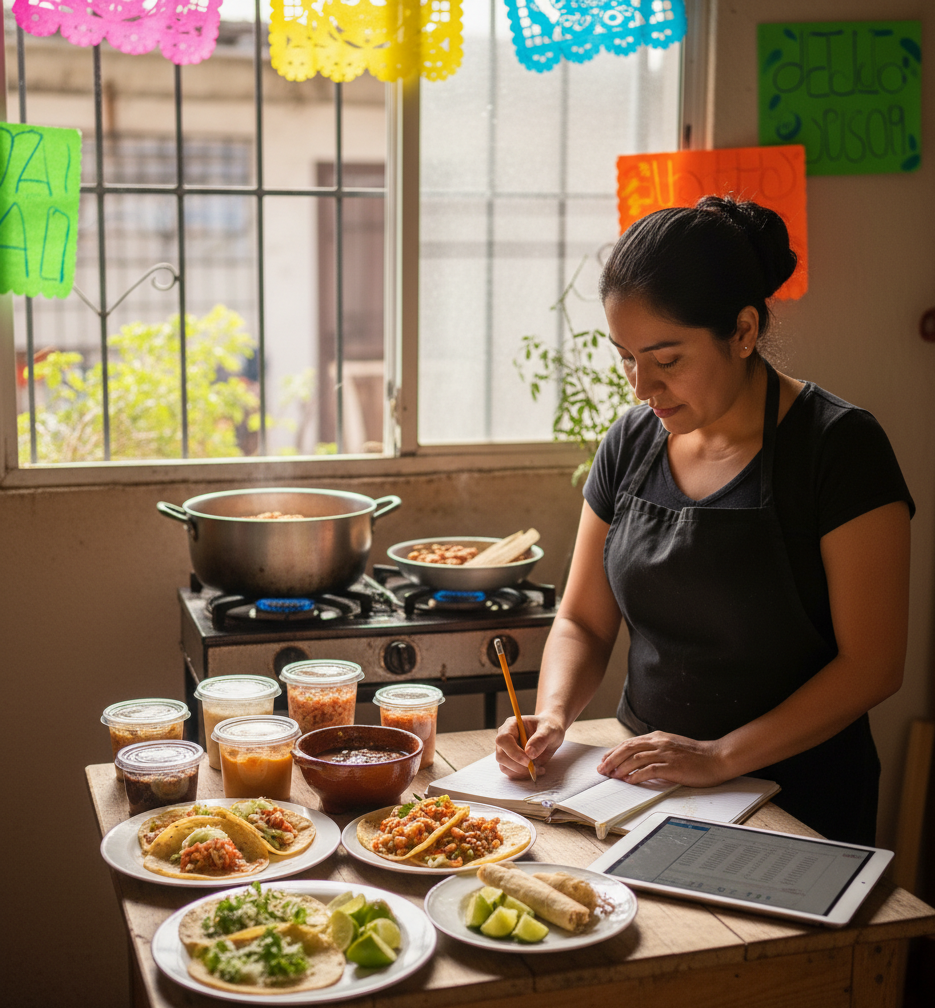


Choosing a profitable menu for a home-based food business in Mexico is one of the most important decisions to ensure financial stability. Many entrepreneurs make the mistake of offering too many dishes or selecting popular recipes without analyzing costs, demand, and profit margins.
In a country where, according to INEGI, most economic units are microbusinesses, profitability depends more on strategy than on volume. It’s not about selling more, it’s about selling with margin.
Here’s how to do it correctly.
🎯 What Does “Profitable Menu” Really Mean?
A profitable menu is not the most elaborate or the most visually appealing.
It is one that:
-
Has a healthy profit margin
-
Is efficient to produce
-
Reduces waste
-
Matches your operational capacity
-
Has consistent demand
Profitability is a balance between cost, price, and sales volume.
💰 Step 1: Calculate the Real Cost of Each Dish
Many entrepreneurs underestimate this step.
You must calculate:
-
Exact ingredient quantities per portion
-
Proportional gas and electricity costs
-
Packaging
-
Delivery expenses
-
Time invested
Basic formula:
Total dish cost + desired margin = final price
A healthy food business margin usually ranges between 50% and 70% over cost, depending on the model.
📊 Step 2: Choose Strategic Ingredients
A profitable menu shares ingredients across dishes.
For example:
-
Chicken used in different preparations
-
Rice or pasta as base options
-
Reusable sauces
This reduces inventory costs and food waste.
Buying ingredients in bulk also improves margins.
🏢 Step 3: Consider the Corporate Market
In Mexico, the service sector represents a large share of formal employment, meaning high concentration of office workers.
A balanced, practical executive lunch menu often has steady demand.
This is where platforms like Homlunch allow you to connect with corporate clients looking for:
-
Quality
-
Punctual delivery
-
Professional service
-
Invoicing options
Recurring orders help stabilize income.
🍽 Step 4: Simplify Your Offer
One of the most common mistakes is offering too many options.
A reduced menu:
-
Simplifies purchasing
-
Reduces waste
-
Speeds up production
-
Improves quality control
Many successful food businesses operate with:
-
Menu of the day
-
Two main options
-
Fixed side dishes
Specialization increases efficiency.
📈 Step 5: Analyze Margin, Not Just Sales
A popular dish is not always profitable.
Ask yourself:
-
How much do I truly earn per unit?
-
Does it take too much time to prepare?
-
Does it create waste?
The goal is not to sell more. The goal is to earn more.
🧠 Trends That Influence Profitability
Mexican consumers value:
-
Healthier options
-
Proper portion sizes
-
Reasonable prices
-
On-time delivery
Balanced executive menus tend to offer more stability than complex gourmet dishes with low sales volume.
❓ Frequently Asked Questions
Which dishes are the most profitable?
Typically, those made with accessible ingredients and simple production methods, such as stews, pasta dishes, and versatile protein-based meals.
How many dishes should I offer at the beginning?
Between 2 and 5 options is ideal to maintain operational control.
How do I know if my price is correct?
If it covers costs, leaves margin, and customers accept it without constant resistance, you’re on the right track.
🚀 Conclusion
Choosing a profitable menu for a home-based food business in Mexico is not just about creativity, it’s about financial strategy.
Calculate your costs precisely.
Simplify your menu.
Choose ingredients strategically.
Focus on recurring clients.
If you want stability and access to companies that value punctuality and quality, register on Homlunch and professionalize your model from the beginning.
A good menu attracts customers.
A profitable menu builds a business.